All sections of our review, with source images available on demand.
OUR REVIEW
Why we are speaking out
Our son had only just turned four when this began. We knew him as a typical young child who could be shy. That is our account of the child at the centre of this review. The later independent language assessment found that he was developing within normal limits and stated: “Further intervention is not recommended at this time.”Read the November 3 assessment.
INDEPENDENT SLP · 3 NOVEMBER 2026“Further intervention is not recommended at this time”
We challenged decisions made about our child’s educational coding and asked to see the evidence behind them. We raised concerns with BCESA and pursued a board review. We do not consider the matter resolved.
We trusted BCESA to explain what was being recorded about our child and why. Instead, we had to make a formal complaint to get answers. We are still not satisfied. Changes to future procedures do not explain the decisions made about our son.
We are naming Bragg Creek Education Services Association because this is the organization responsible for the decisions and grievance process we challenged. We are publishing the relevant documents so other parents can assess our criticism for themselves. This is our family’s experience; we do not claim to speak for other families.
FUNDING: THE CONVERSATION AT THE HEART OF OUR COMPLAINT
Why was this code chosen, and what funding was sought?
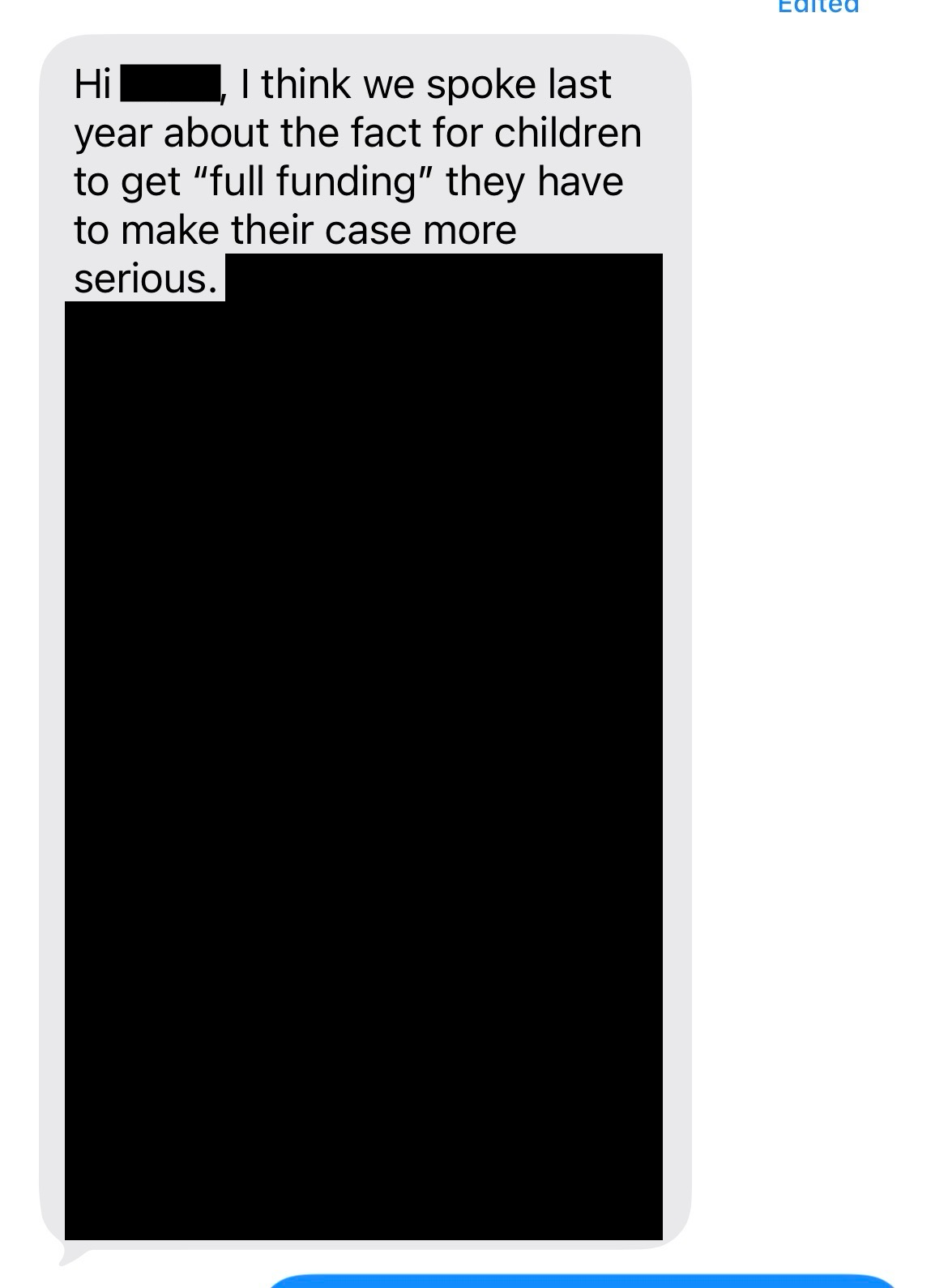
The message explicitly connects “full funding” with making a child’s case “more serious.” This is the statement at the heart of our concern about funding incentives and the way our child’s needs were described.
“for children to get ‘full funding’ they have to make their case more serious.”
The words “more serious” and “full funding” are why this message matters to us. We expected an accurate account of our child’s needs and an explanation of the code before it was entered.
View source: The “full funding” messageMessage excerpt sent to our family. The sender’s identity is withheld. The supplied screenshot has no visible sender header or date. Only the opening sentence is shown; the recipient’s name and all subsequent text are redacted. This is not the complete message. Open full size
We are concerned that funding considerations may have influenced how our child’s needs were described. The message’s connection between “more serious” and “full funding” requires a clear explanation. We want BCESA to address these words directly: what did “make their case more serious” mean, who determined the severity, and what evidence supported the description submitted for our child?
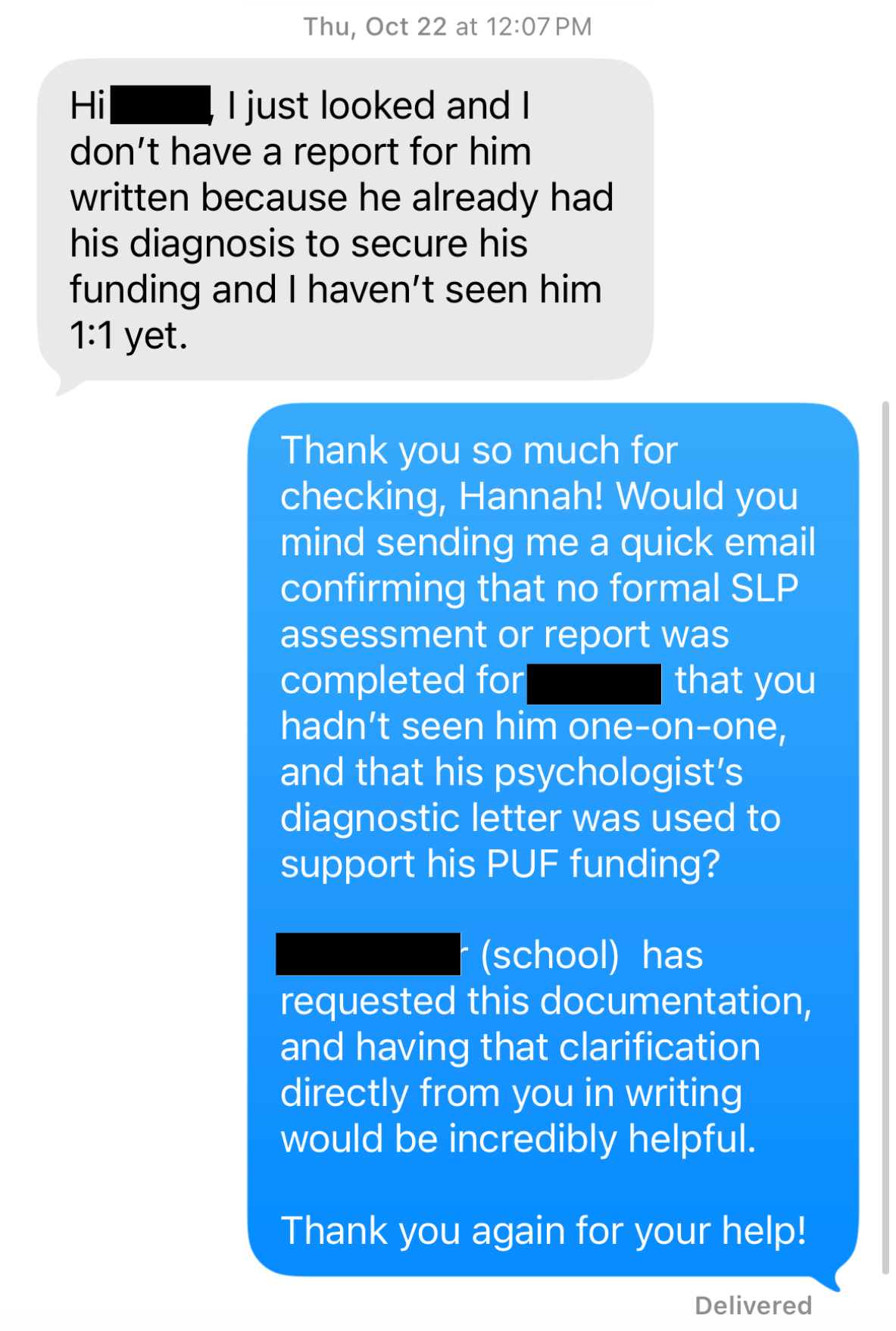
The October message about funding and assessment.
“I don’t have a report for him written because he already had his diagnosis to secure his funding and I haven’t seen him 1:1 yet.”
The recovered screenshot shows this message in the exchange with the SLP, with an October 22 timestamp. Our reply asks for written clarification of what assessment had been completed and how the diagnosis was used for PUF funding. The screenshot does not show an answer to that request.
View source: The October 22 SLP messageOriginal message screenshot, cropped to the October 22 exchange. Parent and child identifiers redacted; the parent’s reply is retained for context. Open full size
That explanation deepened our concern that securing funding was taking priority over explaining and documenting our child’s needs. A diagnosis being available to secure funding did not answer our questions about the assessment, the severe designation, or the evidence supporting it. We expected a clear, documented account of our child’s needs and the decisions made about him.
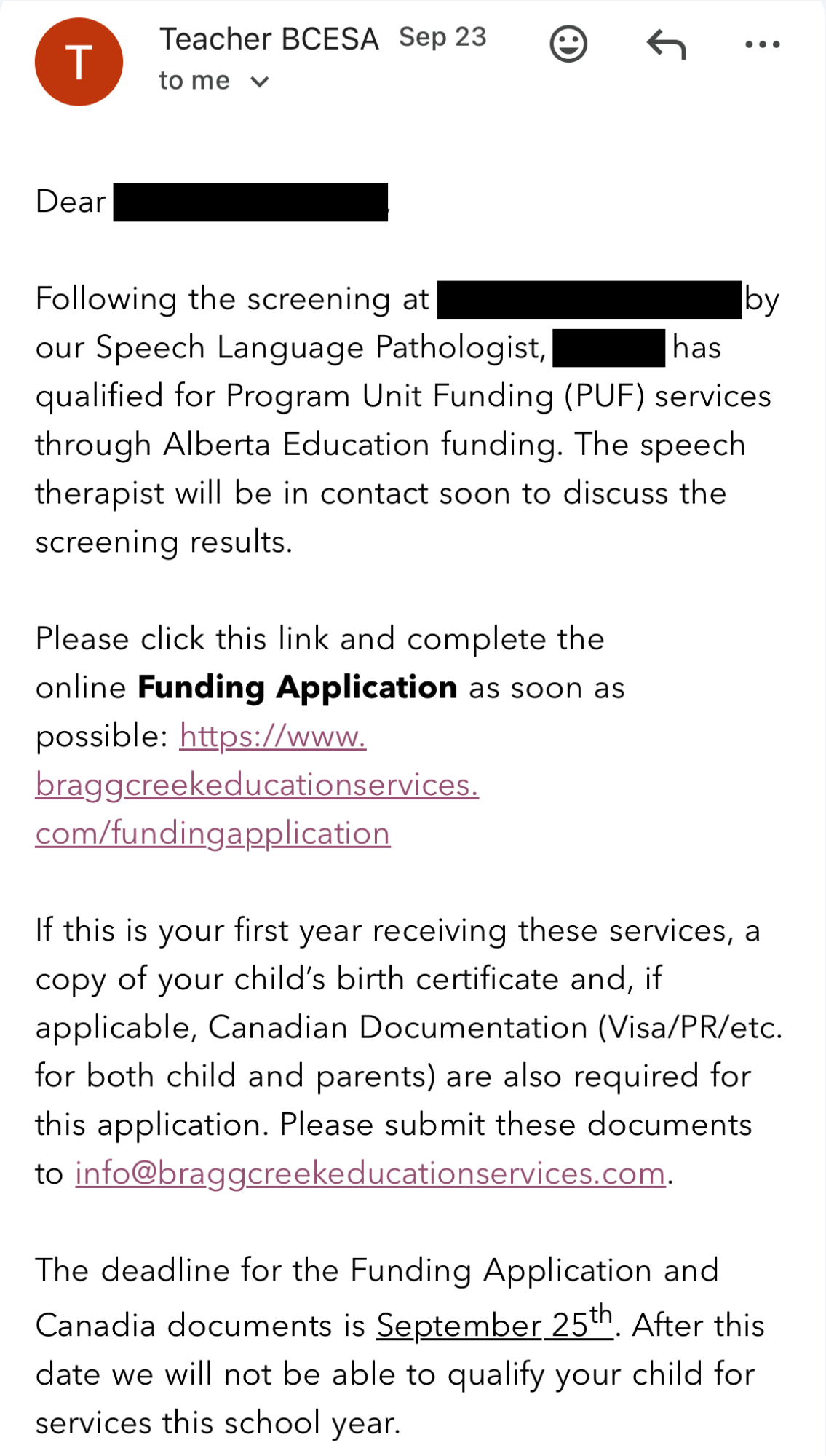
The September 23 email says our child qualified for Program Unit Funding following screening, says the speech therapist would contact us to discuss the results, and asks us to complete the application by September 25. We want BCESA to explain exactly what evidence supported that funding eligibility statement and the subsequent Code 44 decision.
View source: September 23 funding emailOriginal September 23 email from “Teacher BCESA.” Parent, child and preschool identifiers redacted; visible email body retained. Open full size
What we still want explained
BCESA received no funding for our child. We stopped the process before payment. This is our family’s account of the outcome. Our complaint concerns the coding decision and the funding sought before we intervened. We want the original assessment and tracking records, the reasoning behind the severity designation, and details of any funding application submitted or approval obtained before the process stopped. We also want a direct answer to the message about “full funding” and making a child’s case “more serious.”
Our child’s educational record should reflect his needs accurately. We believe BCESA owes our family a much clearer explanation than we have received.
Evidence shown: the parent-provided funding message, the recovered October 22 message and September 23 funding email. The funding message documents the wording above. Our family confirms that no funding was received. The original assessment records and details of the funding sought remain outstanding questions. BCESA’s position is recorded separately below.
INDEPENDENT SLP ASSESSMENT · 3 NOVEMBER 2026
We reject Hannah Schmitt’s severe characterization of our child.
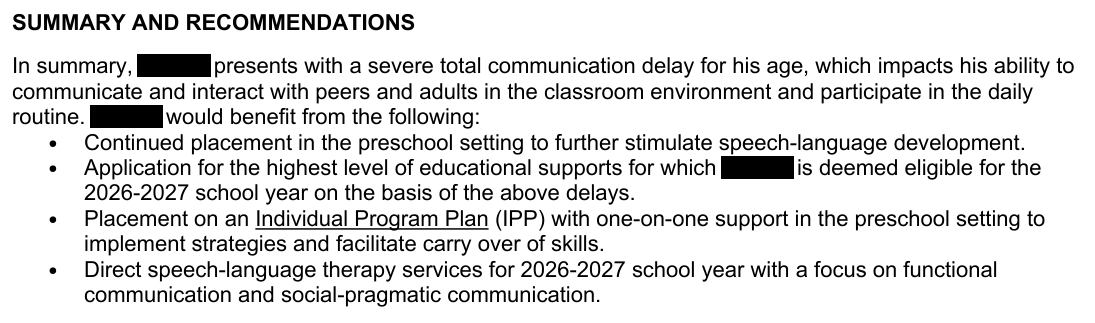
Hannah Schmitt’s report, dated October 26, describes a severe total communication delay in the educational setting. It lists a September 22 assessment and describes informal play-based interaction, consultation and classroom observation in place of formal testing. Read the original report and assessment chronology.
The independent November 3 assessment used formal CELF-P3 testing as well as clinical observation. The summary states that our child was developing within normal limits and recommends no further intervention at that time. We do not believe the informal assessment described in Hannah’s report justified characterizing our child’s communication delay as severe. The later formal findings reinforce our rejection of that severe characterization. Our child deserved a conclusion supported by a clear and convincing assessment of his actual needs.
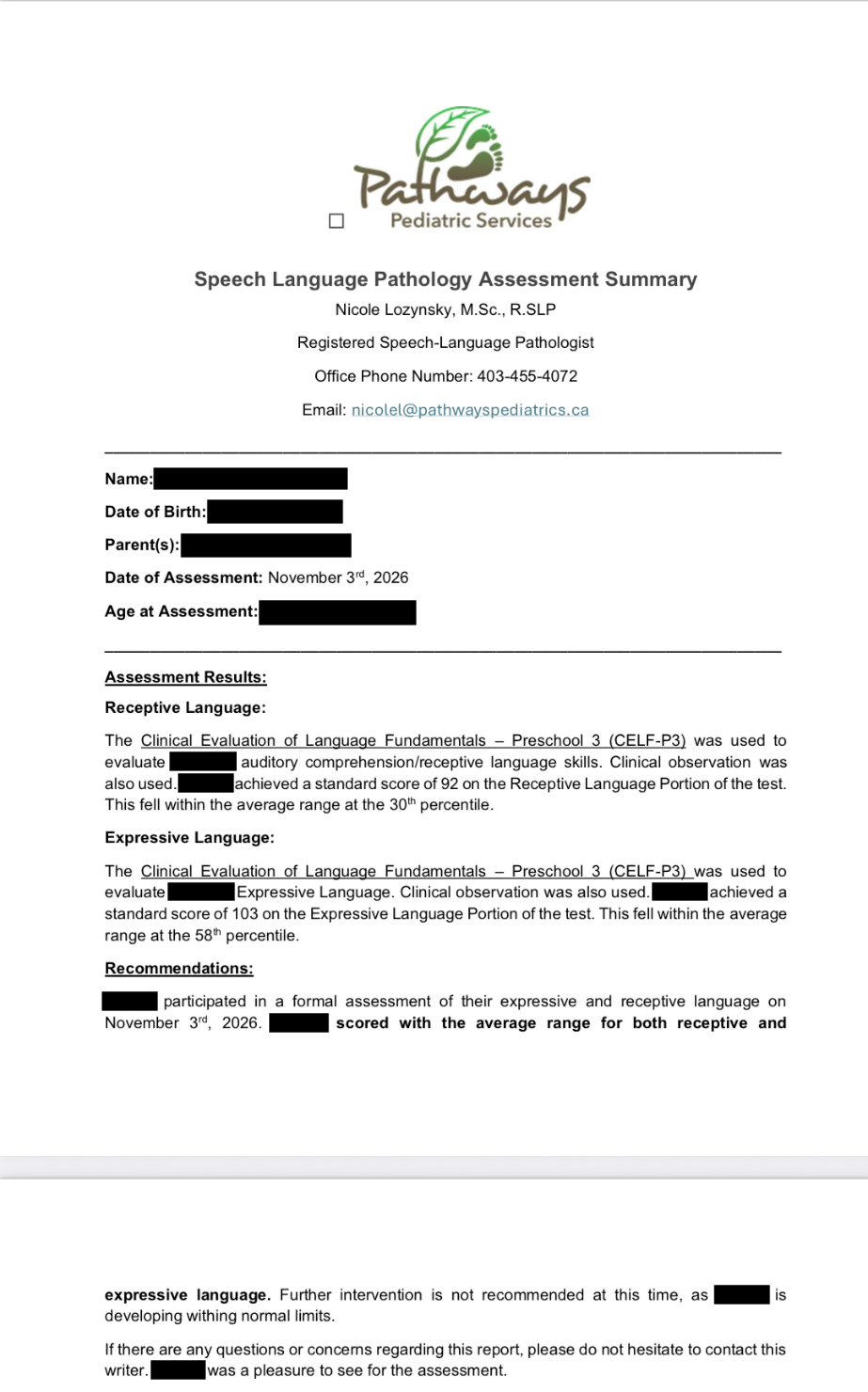
Nicole Lozynsky, M.Sc., R.SLP, of Pathways Pediatric Services assessed our child on November 3, 2026. Her summary describes formal testing with the Clinical Evaluation of Language Fundamentals – Preschool 3 (CELF-P3), together with clinical observation.
Receptive language: standard score 92, 30th percentile, within the average range.
Expressive language: standard score 103, 58th percentile, within the average range.
INDEPENDENT SLP RECOMMENDATION · 3 NOVEMBER 2026“Further intervention is not recommended at this time”
The recommendation explains that our child was developing within normal limits. These findings are one reason we do not accept the earlier description of a severe communication delay.
The board’s November 10 letter states that the external/private SLP report was not provided to it and could not be considered in its review. Read that statement on page 1. The assessments took place on different dates and used different methods and settings. The November 3 language findings do not, by themselves, determine whether the earlier educational code was appropriate or establish anyone’s motive. We want BCESA to explain how its earlier conclusions relate to this later assessment.
View source: Independent SLP reassessmentParent-supplied screenshot excerpt. Family identifiers are redacted; device interface, signature and an incomplete lower score-table fragment are omitted. The visible findings and recommendation are preserved. Open redacted source.
WHAT CODE 44 ACTUALLY MEANS
Why we dispute the Code 44 designation.
Code 44: Severe Physical or Medical Disability
Alberta’s published criteria describe a diagnosed physical, medical or neurological condition that severely affects a child’s functioning and learning at school and requires extensive adult help and changes to the learning environment.
Examples include cancer, cerebral palsy and brain injury, as well as autism, FASD, Tourette syndrome, selective mutism and social communication disorder. These are examples, not automatic qualifications. Sharing a code does not mean children have the same diagnosis or needs.
Edition check, 22 November 2026: the 2026–27 criteria are linked by Wetaskiwin Regional Public Schools, but the government PDF returned an access error during verification. The summary above identifies the earlier official edition verified; it is not a determination of our child’s eligibility under the current rules.
Alberta calls Code 44 “Severe Physical or Medical Disability.” BCESA’s board says it was entered for our child on September 29. We dispute its application to our child.
We are angry about a severe designation we challenged, the explanations we received, and the record left behind. This was not a minor administrative detail to our family. We wanted to understand why this category applied to our child and what evidence justified it.
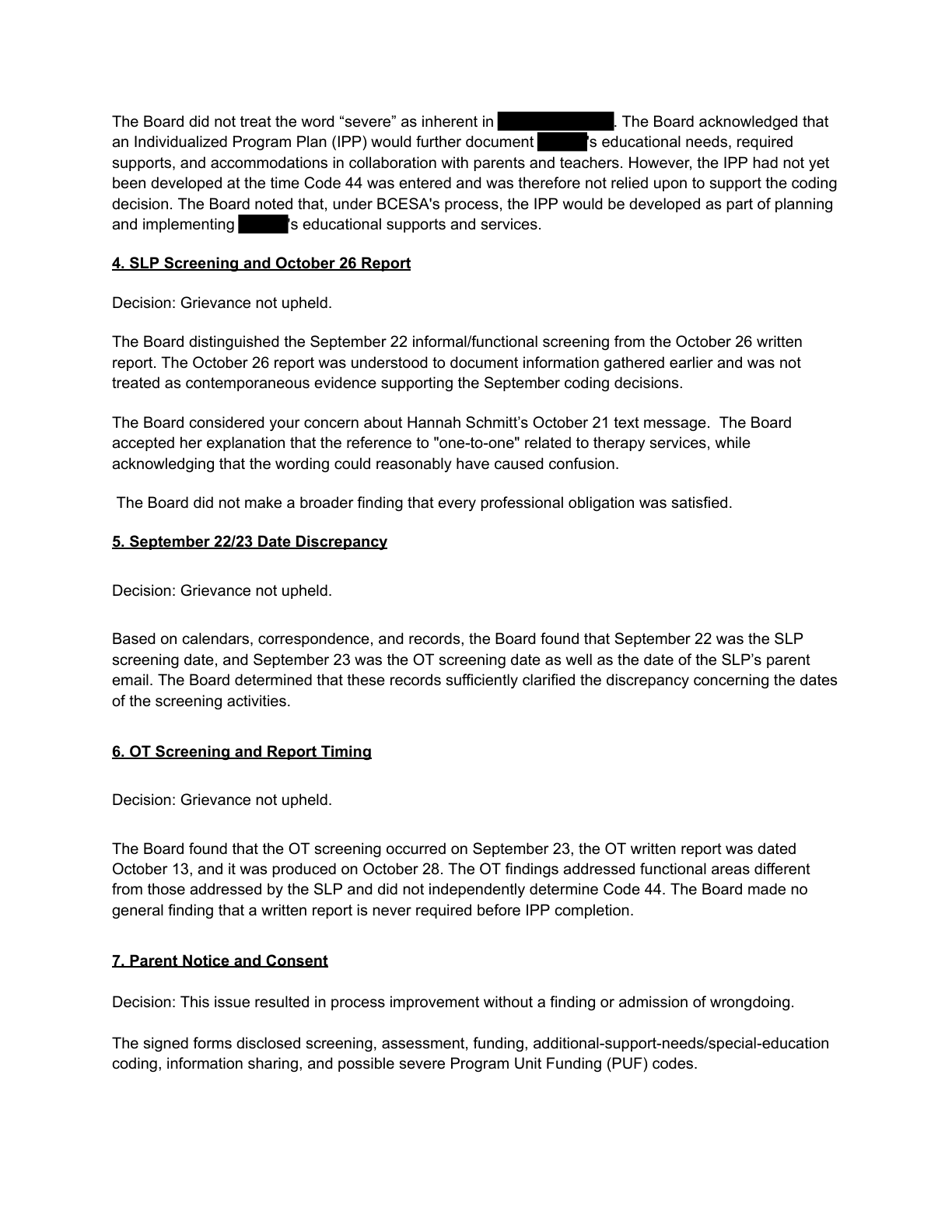
BCESA defended the decision. Yet its own board said the evidence did not establish that the specific designation and its implications were clearly explained to us before entry. How is that an acceptable way to handle a consequential decision about a child?
The board maintained that multiple sources supported the coding decision and approved clearer documentation of severity and educational impact. We want the original evidence and a clear explanation of why it justified this category at the time. Assurances that the decision was appropriate do not answer that question.
Our objection is to a designation we dispute and the way it was handled. It is not a judgment about children who have disabilities or their right to support and opportunity.
We believe this code cost our child a school opportunity.
Our concern was never simply about a code on a form. It was about how that designation could affect the way schools viewed our child, the opportunities available to him, and the record that would follow him.
An educational opportunity we believe was lost
In our signed complaint, we reported that our child was denied even an interview at the school where we wanted him to join his sister, and we attributed that refusal to the assigned code. To us, this was a concrete impact on his educational opportunities, not a hypothetical concern.
View source: Our account of the school refusalSigned parent complaint, page 4, first two sentences of the requested-outcome field. Later text is cropped or obscured. This records our account, not the receiving school’s reasons. Open full size
That is our account of what happened and why. BCESA’s board disputed the causal link: it said it found no evidence establishing the receiving school’s independent rationale or a connection between BCESA’s actions and that school’s decision. The receiving school’s original decision correspondence is not included in the records recovered for this website.
Removing the active code did not erase the history
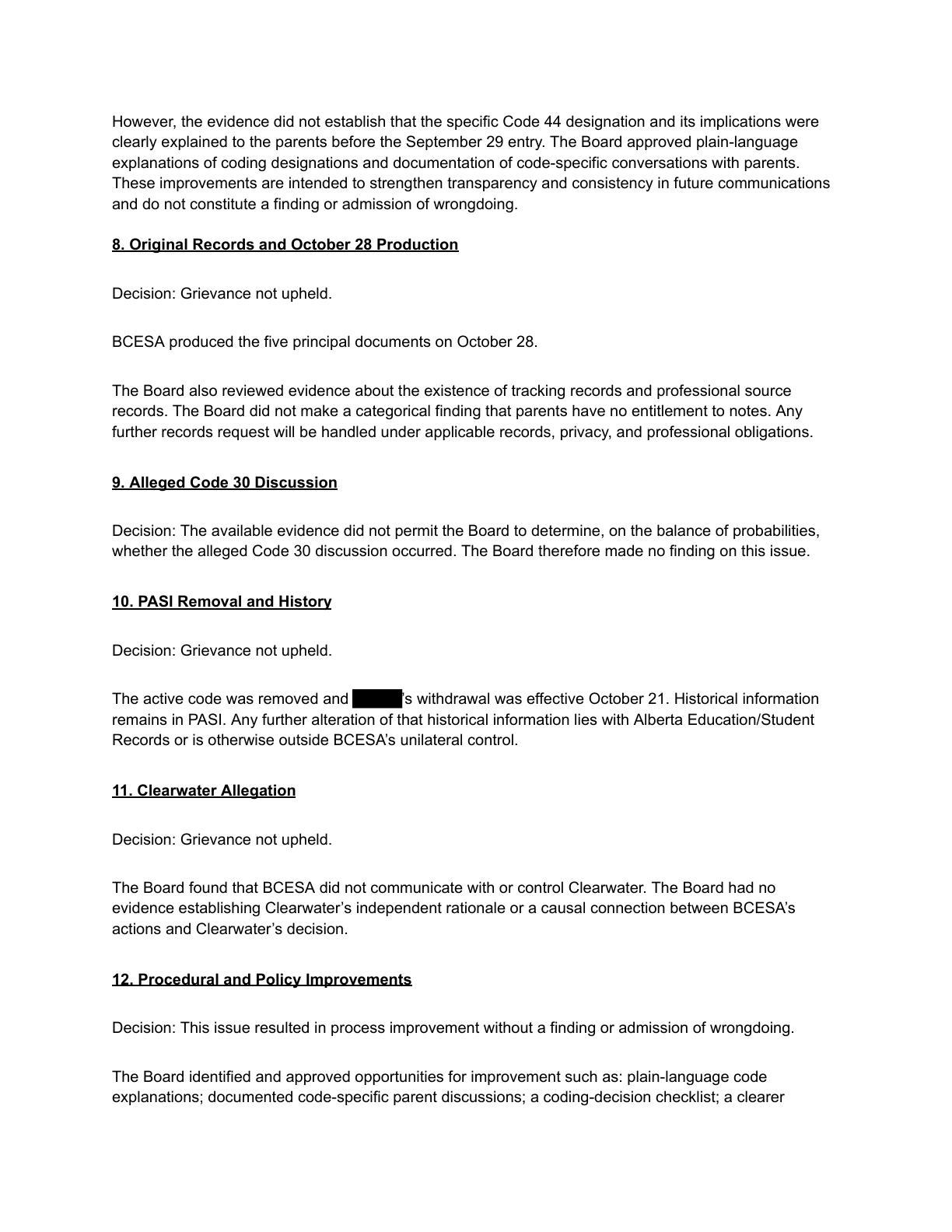
The board confirmed that the active code was removed and withdrawal took effect on October 21. It also said historical information remained in PASI, Alberta’s student information system, and that further alteration was outside BCESA’s unilateral control.
That left us concerned about how future decisions might be influenced by a designation we had challenged. We cannot establish from these records that permanent damage to our child’s future has occurred. But the continuing history is precisely why we take the issue so seriously.
We wanted support that opened doors for our child. We believe this experience instead put an obstacle in his path and left us fighting to understand and challenge the record.
COMMUNICATION
Was the specific designation explained?
The funding form included general information about special-education coding. The board’s November 10 response nevertheless says the evidence did not establish that the specific Code 44 designation and its implications were clearly explained before entry.
Our view: General language on a funding form does not resolve our concern about whether we understood the specific decision.
View source: The board on parent communicationBoard response, page 4. Continuation of issue 7; includes the board’s qualification about wrongdoing. Open full size
The written SLP report followed the coding decision and our grievance.
Hannah Schmitt, the speech-language pathologist who authored the report, needs to answer for this sequence. Her report is dated October 26, lists September 22 as the assessment date, and describes a severe total communication delay in the educational setting. Its methods explicitly include “Informal play-based interaction in place of formal assessment”, alongside parent/teacher consultation and classroom observation.
Our view: We are deeply dissatisfied with Hannah Schmitt’s reporting and explanation of the assessment behind this severe description of our child. We do not accept a report issued after our grievance as a substitute for the original evidence behind decisions already made. We want the observations, notes and reasoning that existed at the time, along with a direct explanation of how they supported the severity described.
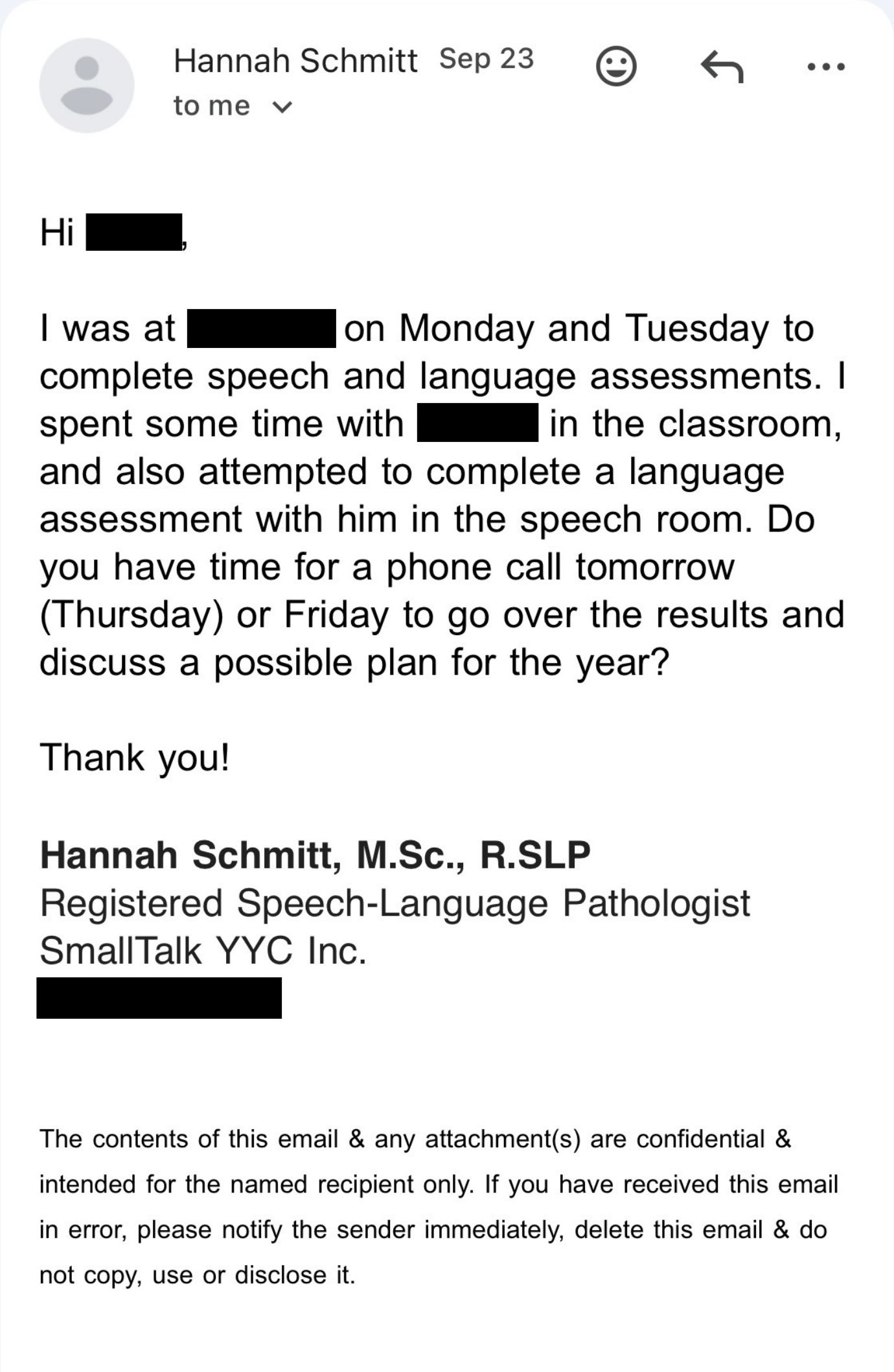
September 23: Her email describes classroom time and an attempted language assessment in the speech room. Read the email.
September 29: The board says Code 44 was entered.
October 22: The recovered message says she did not have a report written because our child already had a diagnosis to secure funding, and that she had not seen him “1:1” yet. Read the message and our reply.
October 23: The board says it received our written grievance.
October 26: The written SLP report is dated after that grievance and nearly a month after the Code 44 entry.
Hannah, what exactly was documented before the coding decision, and how did those records justify the severity described in your later report? Why was there no written report on October 22? Why were we being told that the diagnosis had already secured funding while we were still trying to obtain a clear account of the assessment? These are questions about our child’s record and opportunities, and we expect specific answers.
View source: Report and assessment datesSLP report, page 1: report and assessment dates. Personal fields redacted. Open full sizeView source: Assessment methodsSLP report, page 1: listed assessment methods. Cropped excerpt. Open full size
Our criticism concerns the evidence, timing and explanation in our child’s case. Informal assessment methods alone do not establish that an assessment was invalid. The board said it did not rely on the October report as contemporaneous evidence for the September coding decisions, and accepted that “1:1” referred to therapy. That still leaves our demand for the original supporting records.
What evidence was there when the code was entered?
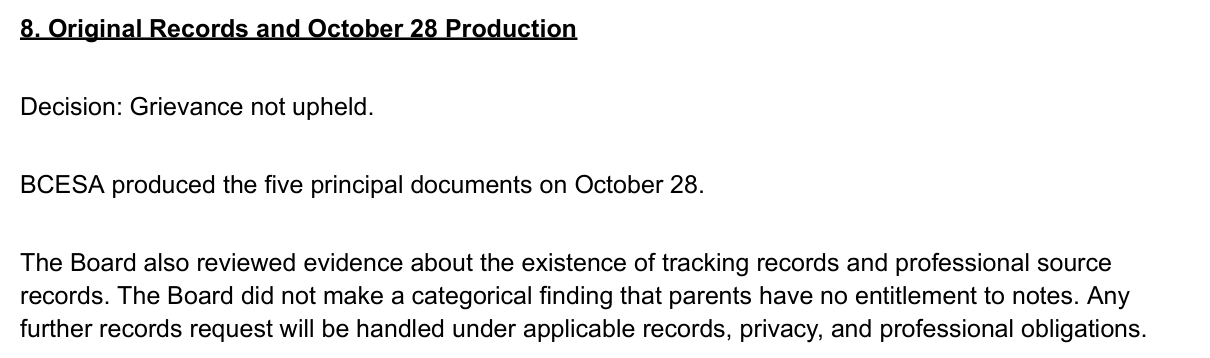
The board says five principal documents were produced on October 28. It also describes tracking records and professional source records, and says further requests will be handled under applicable obligations.
Our position: We maintain that the complete original supporting records have not been provided to us. The board’s letter does not itself reproduce those records.
View source: Original records and productionBoard response, page 4: document production and additional source records. Open full size
The preceding paragraph states our family’s position; the excerpt shows the board’s response.
GRIEVANCE PROCESS
How can parents actually challenge the outcome?
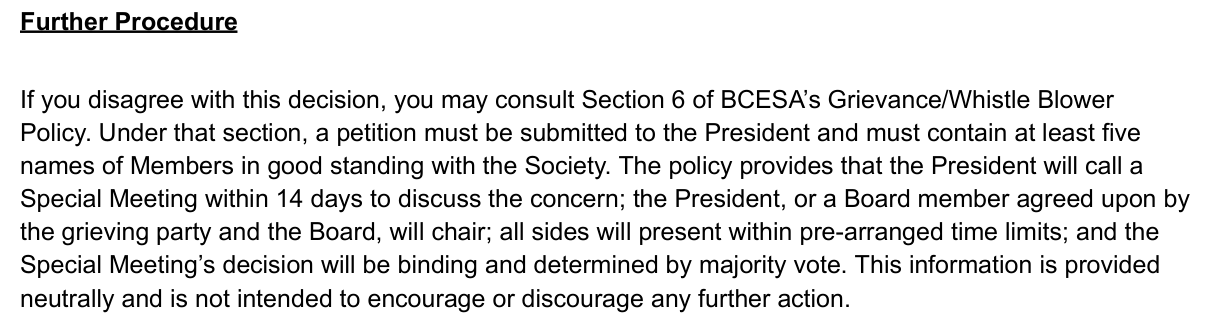
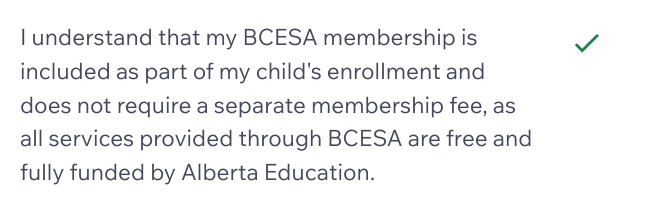
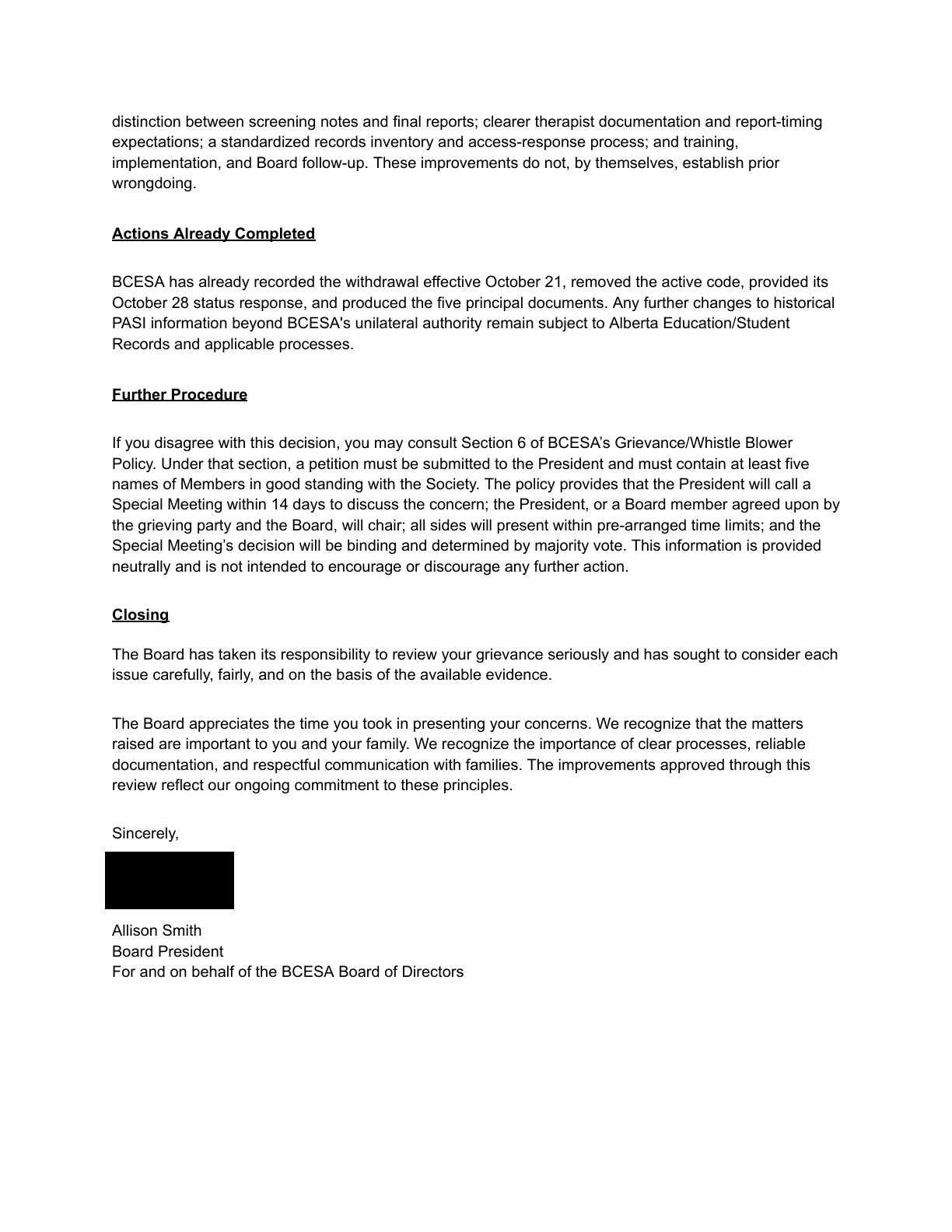
The board describes an internal petition requiring at least five names of members in good standing. The funding form states that membership is included with enrolment, without a separate fee.
Our question: How does a family use this process after withdrawing from services? The form does not settle post-withdrawal eligibility or identify willing supporters.
View source: The five-member petitionBoard response, page 5: five-member petition procedure. Open full sizeView source: Membership termsFunding form, page 3: membership included with enrolment. Open full size
WHAT ACCOUNTABILITY WOULD LOOK LIKE
The records we are asking for
Tell us what records exist.
Identify the original screening notes, tracking entries and observations relied on, what has been provided, and the basis for any withholding.
Explain the original decision.
Show which evidence supported the designation when it was entered, and how its implications were communicated to us.
Tell us how to challenge the decision.
Explain membership after withdrawal and how parents can practically meet the petition requirement.
THE TIMELINE
The records in order
The anonymous funding message and the verbal statement attributed to Michelle Roberts are not assigned dates because their dates are not established in the material shown here.
Funding and assessment emails
BCESA’s email says our child qualified for PUF. The SLP’s separate email describes classroom time and an attempted assessment. Funding email · SLP email
Parent funding form completed
The form covers funding administration, information sharing, coding, and membership.
Coding change
The board’s response identifies this as the date of the Code 44 change.
Message says no report had been written
The screenshot displays October 22; the board later refers to October 21. Read the message.
Written grievance received
According to the board, supplemental submissions followed on October 30.
SLP report dated
The written report describes September observations and consultations.
Independent SLP assessment
Pathways Pediatric Services assessed receptive and expressive language within the average range and recommended no further intervention at that time. Read the findings and source.
Parent complaint form signed
The form records concerns about assessment and reporting. This signed form records our complaint. It does not establish a regulatory finding.
Board response issued
The letter communicates decisions from the November 5 board meeting.
THE DOCUMENTS
Read the source material.
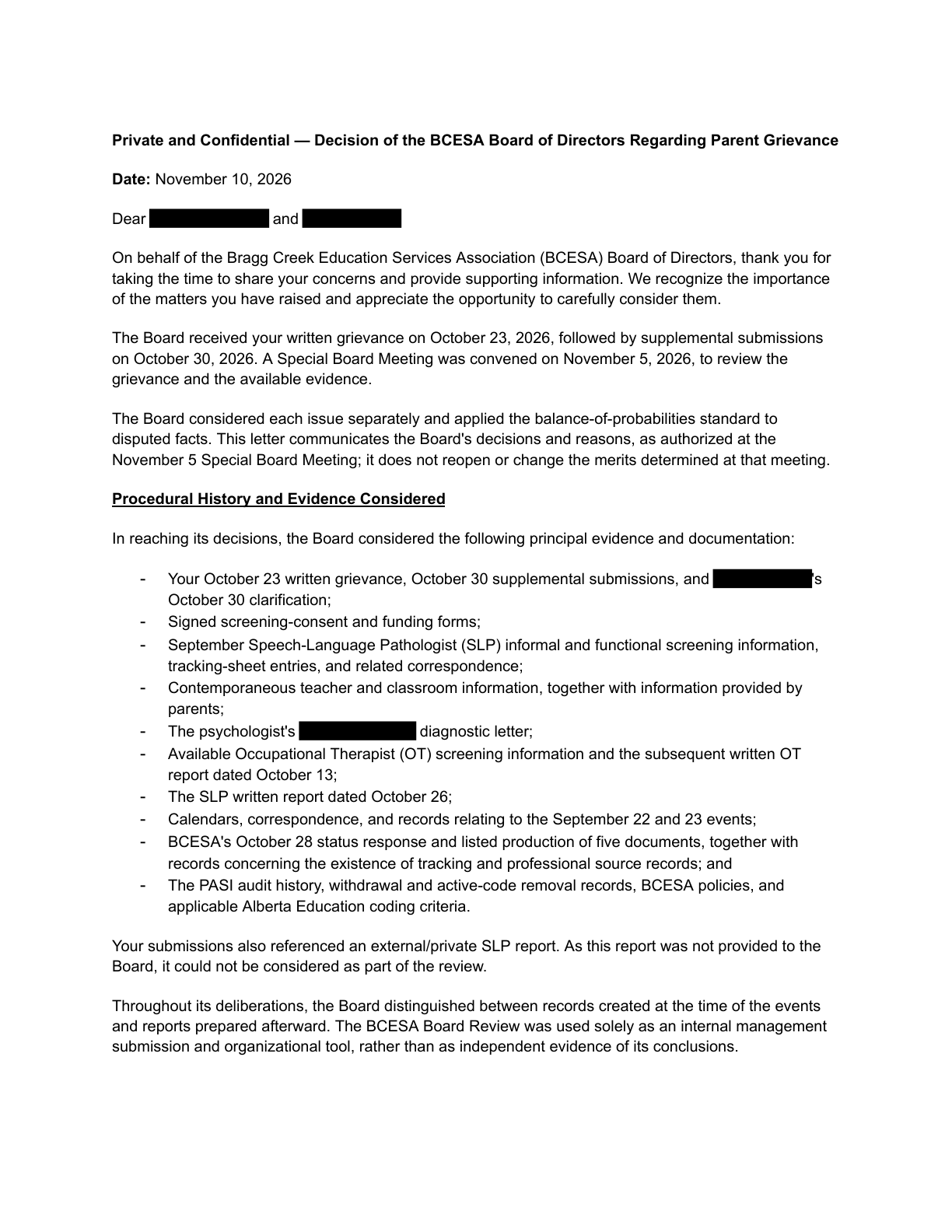
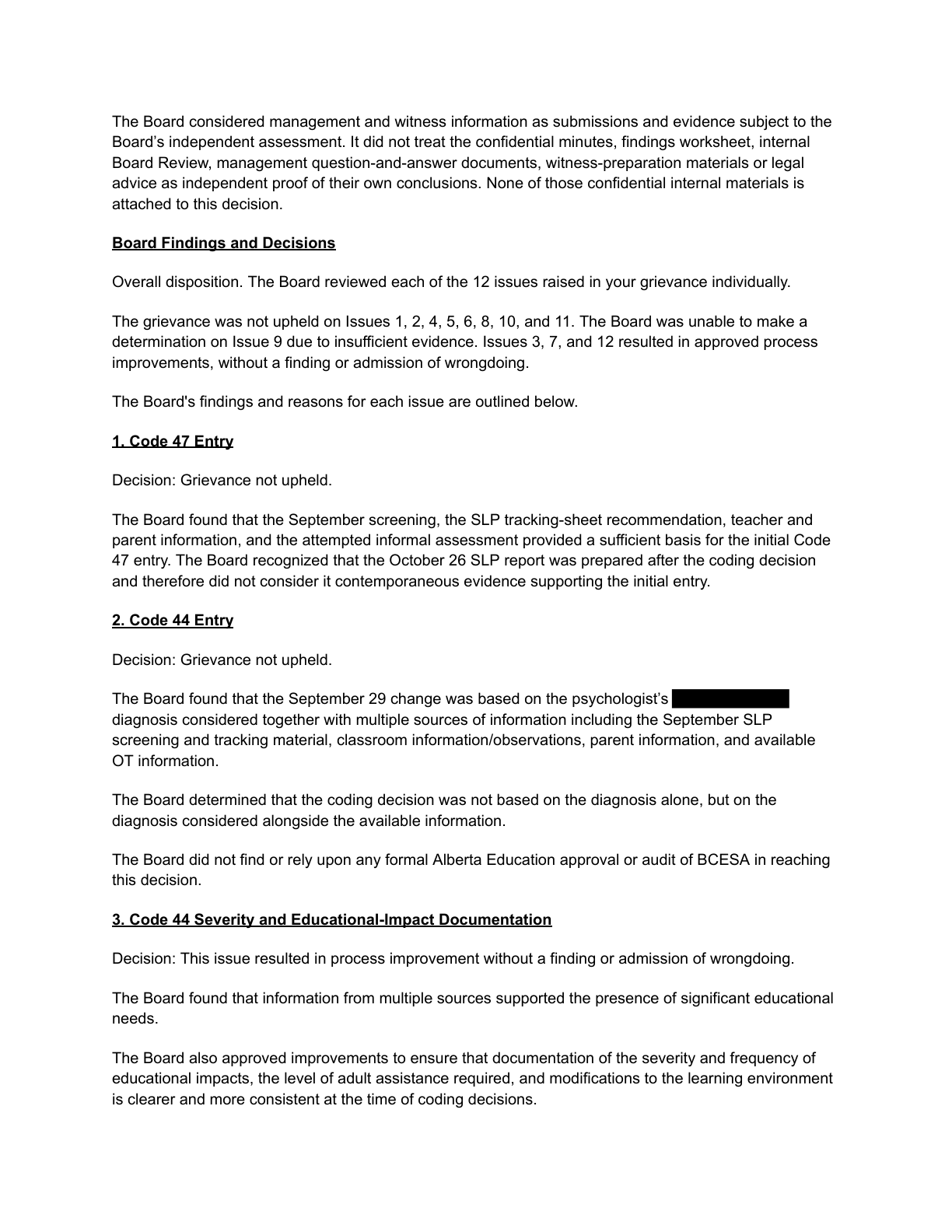
Actual document screenshots, not recreated messages. Black boxes mark redactions. Crops are labelled; the full redacted board response is included for context.
View all five pages of the board responseView source: Board response · page 1BCESA board response, page 1 of 5. Redacted copy. Open full sizeView source: Board response · page 2BCESA board response, page 2 of 5. Redacted copy. Open full sizeView source: Board response · page 3BCESA board response, page 3 of 5. Redacted copy. Open full sizeView source: Board response · page 4BCESA board response, page 4 of 5. Redacted copy. Open full sizeView source: Board response · page 5BCESA board response, page 5 of 5. Redacted copy. Open full size
The September assessment email
The September 23 email describes classroom time and an attempted language assessment in the speech room. Read it alongside the October message: our criticism concerns what was completed, what was documented, and what supported the coding and funding decisions.
View source: September 23 assessment emailOriginal September 23 SLP email. Parent, child and preschool identifiers and telephone number redacted; email text retained. Open full sizeView source: Hannah’s conclusion and recommendationsOriginal SLP report, page 1: summary and recommendations. Child’s name redacted. This cropped excerpt preserves the classroom context and recommendations; it is not the complete report.
Our signed complaint
Our signed complaint alleges that the SLP initially said no assessment had been made and later completed a report. This screenshot records our allegation; it is not an independent finding.
View source: Our signed assessment complaintParent complaint, page 4: allegation recorded in the completed form. Open full size
The board accepted an explanation that “one-to-one” referred to therapy services, while acknowledging that the wording could reasonably have caused confusion. Read that response on page 3. The recovered October 22 message and our reply are now shown above. The message says no report had been written and that the SLP had not seen him “1:1”; it does not itself say that no screening or observation had occurred.
INDIVIDUAL RESPONSIBILITY
Who made the decisions and handled our complaint
Our criticism concerns the decisions, statements and review process in our child’s case. Each account below identifies its source.
Allison Smith signed the November 10 response on behalf of the board. That response upheld the coding decisions while approving improvements to severity documentation and code-specific parent communication. We still want to know what evidence supported this code when it was entered.
The board needs to explain its decision and show which promised changes have actually been made. The signed letter does not set out implementation deadlines or identify the person responsible for each change.
According to our family’s account, Michelle Thompson-Blair conducted the initial internal review and told us she found no wrongdoing within the organization. We did not accept that response. It did not answer our questions about the assessment, what we had been told about the code, or the funding sought.
We hold the initial review accountable for the evidence it examined and the reasons it gave. This was a separate stage from the later board decision signed by Allison Smith.
Family account supplied November 22, 2026. The original initial-review response is not attached here; this account is a paraphrase, not a quotation or a finding by an independent body. Her role is listed on BCESA’s official team page.
Our account is that Michelle Roberts verbally told our child’s mother she would change the code. We were disputing the code when she said this. Changing the active code, withdrawing the application and removing historical information are different actions.
Hannah SchmittSpeech-language pathologist · assessment and report
Hannah Schmitt authored the October 26 report describing a severe communication delay, using informal methods and observations. The report followed the September 29 coding decision and the board’s receipt of our grievance. We challenge the severity conclusion and the adequacy of the evidence documented at the time.
The September email describes an attempted assessment. The October message says no report had been written and she had not seen our child “1:1” yet. Those records require explanation; informal methods and a later report date alone do not establish fabrication.
The board did not agree with most of our grievance.
In our view, BCESA’s internal review failed to hold its staff accountable. Our complaint questioned whether funding had influenced the description of our child’s needs. We do not think the organization’s review answered that concern. Promising changes did not settle our complaint about what had already happened.
Its November 10 letter did not uphold eight of twelve issues, could not determine one because of insufficient evidence, and approved process improvements on three without a finding or admission of wrongdoing.
The board upheld the coding decisions. It listed a coding-decision checklist, documented code-specific parent conversations, clearer therapist documentation and report-timing expectations, a standardized records process, training and board follow-up. The letter does not set implementation deadlines or identify the person responsible for each change. We want a documented implementation plan and confirmation of what has been completed. We remain dissatisfied with the outcome; that disagreement should not be mistaken for a finding of misconduct.
On the disputed assessment message, the board accepted the explanation that “one-to-one” referred to therapy, while acknowledging confusing wording. The recovered screenshot is now included above. It displays October 22; the board’s discussion refers to October 21. We retain that date discrepancy rather than silently changing the source.
This independent review is based on a parent funding form, the original SLP report, a screenshot of a subsequent independent SLP assessment summary, a signed complaint form, parent correspondence, recovered message and email screenshots, and the board’s November 10 response. Document summaries are paraphrases. Relevant document screenshots and a redacted board response are attached above. Family names, identifying fields, selected child health information and a signature are redacted. Professional names discussed in the review remain visible. Clinical sections not necessary to the review are omitted from the excerpt packet.
This website is not affiliated with BCESA. It describes one family’s experience and does not claim to represent other families. It does not establish fraud, unlawful conduct, or professional misconduct.
FUNDING AMOUNTS AND SOURCES
Reported severe-disability grant rates: up to $31,219.65 a year.
We believe funding influenced the severe designation assigned to our child. The message sent to our family said children’s cases had to be made “more serious” to receive full funding. Read alongside the potential rates below, that message is why we question whether the pursuit of funding took priority over an accurate description of our child’s needs. This is our interpretation of our family’s experience, not an established motive for every Code 44 assignment. A Code 44 designation alone does not establish eligibility for these amounts.
AUVIE’s 2026–27 funding guide, marked checked October 28, 2026, reports annual severe-disability PUF rates of $18,731.79 for a half-day program and $31,219.65 for a full-day program. It describes full-day eligibility as requiring at least 800 hours and says funding goes to the provider for education and support.
Verification status: these are secondary-source reported rates. The guide links to Alberta’s 2026–27 funding manual, which could not be retrieved for independent verification on November 19, 2026. We have not verified which rate, hours or allocation adjustments applied to our child.
Our family stopped the process before payment. BCESA received no funding for our child. The figures above describe potential grant rates, not money BCESA received. We want the records of any application and approval before the process stopped, including the amount sought and the eligibility basis. The attached records do not establish that the full-day rate applied or what amount was sought.